
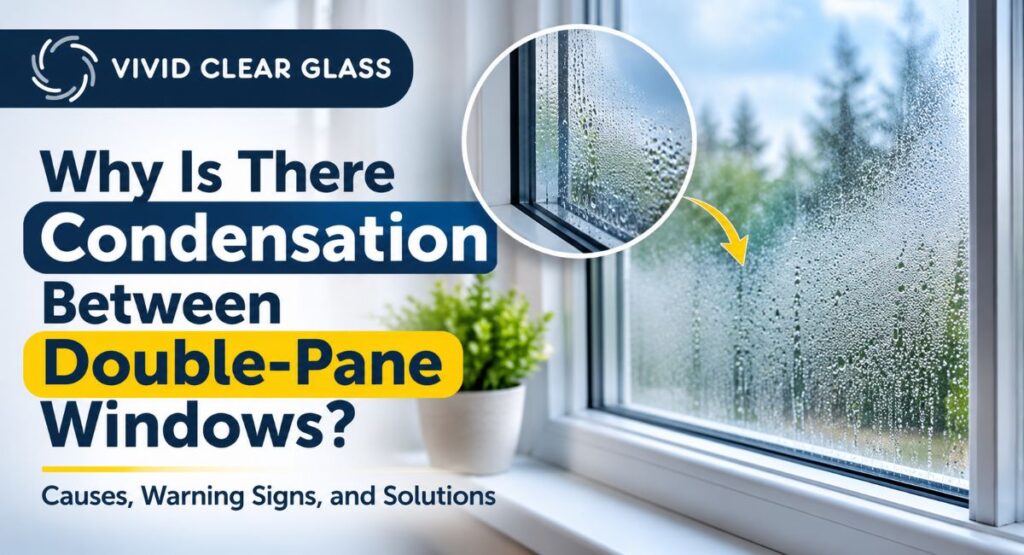
You wipe the window. The fog stays. You wipe again. Nothing changes. The haze is not on the glass you can reach. It sits inside the window, between the two panes.
This is a common problem in Florida homes. It looks small at first. A faint cloud in one corner. A few water drops after a humid morning. Then the cloud grows, and the view gets worse.
So why is there condensation between double pane windows? In most cases, the sealed unit has failed. Moisture has entered the space that should stay dry. Once that happens, cleaning will not fix it.
This guide explains what causes fog between glass panes, how to tell it apart from normal condensation, and what to do next. You will also see which repairs work, which do not, and when replacement makes sense.
What a Double Pane Window Is Made Of
A double pane window is not just two sheets of glass. It is a sealed assembly called an insulated glass unit, or IGU. Each part has a job.
The main parts of an insulated glass unit
- Two panes of glass. These form the outer and inner faces.
- A spacer. This is a thin frame that keeps the panes apart. It is often made of aluminum, stainless steel, or a foam material.
- Desiccant. This is a drying agent inside the spacer. It absorbs small amounts of moisture.
- Primary seal. This is a sealant that bonds the glass to the spacer. Many units use polyisobutylene (PIB).
- Secondary seal. This is a second layer of sealant around the edge. Silicone or polysulfide is common.
- Gas fill. Many units hold argon or krypton between the panes. These gases slow heat transfer better than air.
The space between the panes is called the airspace. It is meant to stay sealed for years. It holds dry air or gas. That dry space is what gives the window its insulating value.
Why the seal matters
Heat moves through glass by conduction, convection, and radiation. A sealed airspace slows that movement. This helps keep cool air inside during a Florida summer. It also reduces strain on your air conditioning system.
When the seal fails, outside air enters. That air carries humidity. The desiccant fills up. Then moisture has nowhere to go. It condenses on the inner glass faces.
The Three Kinds of Window Condensation
Not all window fog means the same thing. Three types exist. Only one points to a failed seal.
1. Interior condensation
This forms on the room side of the glass. It happens when warm, humid indoor air meets a cooler glass surface. Water vapor turns into liquid.
Common causes include:
- Showers and cooking
- Drying clothes indoors
- Running the air conditioner very cold with humid air inside
- Poor ventilation
- Houseplants and fish tanks
You can wipe this off. It returns when conditions repeat. It is a humidity problem, not a seal problem.
2. Exterior condensation
This forms on the outside of the glass. It often surprises homeowners. It happens when the outer pane is cooler than the outdoor dew point.
In Florida, this is common in warm, humid weather. Cool indoor air from your air conditioner chills the glass. Humid outdoor air touches the surface. Water droplets form on the outside.
This is often a sign of good insulation. Efficient windows keep the outer pane cool. You can wipe it away from outside. It usually clears as the sun warms the glass.
3. Condensation between the panes
This forms inside the sealed airspace. You cannot reach it. You cannot wipe it off. It means the seal has been compromised.
You may see:
- Fog or haze that comes and goes
- Water droplets on the inner faces
- A permanent cloudy patch
- White or gray mineral film
- Streaks that dry in patterns
This is the type that needs attention.
A quick comparison
| Type | Where it forms | Can you wipe it off? | Main cause | Seal problem? |
| Interior condensation | Room side of glass | Yes | High indoor humidity | No |
| Exterior condensation | Outdoor side of glass | Yes | Cool glass, humid outdoor air | No |
| Between the panes | Inside the sealed unit | No | Failed IGU seal | Yes |
How to Tell If You Have a Failed Seal
You do not need special tools for a first check. A few simple steps help.
The wipe test
- Clean both sides of the glass with a soft cloth and glass cleaner.
- Dry the glass fully.
- Look at the haze again.
If the fog is gone, it was surface dirt or normal condensation. If the haze stays, it is inside the unit.
The side test
Wipe each side separately. Check after each wipe. The side that clears shows where the problem was. If neither side changes anything, the issue is between the panes.
The time test
Watch the window at different times of day. Fog between the panes often changes with temperature. It may clear in the afternoon sun and return at night. Over time, the clear periods get shorter.
The light test
Hold a flashlight at an angle. Look for:
- A thin film on the inner faces
- Water drops inside
- Dried mineral rings
- A rainbow tint
A rainbow tint can also come from glass coatings. Compare it with other windows in the home. Check whether the pattern appears in only one unit.
The reflection test
A trained technician may use a small light or a reflection method. A candle or lighter flame reflection shows how many glass surfaces exist. This method has limits. Do not use open flames near windows or coatings. Use a flashlight instead.
What Causes Moisture Between Window Panes
A seal rarely fails for one reason. Several forces act on it over time. Florida homes face a tougher mix than most.
Age and normal wear
Sealants age. They lose flexibility. Small cracks form. Many sealed units last well over a decade. Some last much longer. Others fail early. Quality varies by manufacturer, materials, and conditions.
Warranty terms often cover seal failure for a set period. Check your paperwork. Many warranties run 10 to 20 years, though terms differ.
Heat and UV exposure
South Florida has strong sun year round. Heat expands the glass, the spacer, and the sealant. Cooling shrinks them. This cycle repeats daily.
Ultraviolet light also breaks down sealants. West and south facing windows take the most exposure. Failures often show up there first.
Pressure changes and thermal stress
The sealed airspace reacts to temperature and pressure. When pressure shifts, the glass flexes. This movement stresses the edge seal. Over many cycles, small gaps can open.
Dark window films or heavy tints can add heat to the glass. This increases stress. Poorly matched films can contribute to seal failure in some cases. Check film compatibility with the window manufacturer.
Storm stress
Hurricanes and tropical storms push and pull on windows. Wind pressure flexes the glass. Debris can strike the frame. Frame movement can open edge gaps.
A window may look fine after a storm. The seal damage may show up weeks later. This is why a post-storm review matters. You can read a step by step guide on how to inspect windows after a hurricane.
Poor installation
Installers must set the glass and frame correctly. Mistakes include:
- Blocking the weep holes
- Using the wrong sealant
- Setting the unit with uneven support
- Over tightening fasteners
- Leaving gaps in the frame seal
Water that sits against the edge seal speeds up failure. A window that cannot drain properly will fail early.
Frame movement and settling
Homes shift over time. Stucco cracks. Openings move slightly. If the frame twists, the glass edge takes stress. Aluminum frames also expand and contract with heat.
Salt air and corrosion
Coastal air carries salt. Salt can corrode metal spacers and fasteners. It can also affect sealants. Salt film on glass holds moisture against the frame edge. Over years, this adds wear.
Manufacturing defects
Some units leave the factory with weak seals. Poor sealant coverage, contaminated surfaces, or low quality desiccant can cause early failure. This is less common. It is more likely if several units fail at the same age.
Warning Signs Beyond the Fog
Fog is the clearest sign. Other signs often appear as well.
Visual signs
- Cloudy patches that grow
- Water droplets that sit inside the glass
- Mineral streaks or spots
- Fog that appears after rain or humid mornings
- A hazy cast on one window only
Performance signs
- A room that feels warmer near the window
- A drop in comfort during peak sun
- Higher cooling bills
- More noise coming through the glass
When the gas fill leaks, insulation drops. You may notice the room does not hold temperature as well. The change is gradual. It is often easy to miss.
Frame and edge signs
- Cracked or missing sealant around the glass
- Gaps at the glazing bead
- Rust or corrosion at the frame
- Stains on the interior wall below the window
Check all of these together. A single sign does not prove a failure. A pattern does.
Is Condensation Between Panes Dangerous?
It is rarely an immediate safety risk. The glass is usually still intact. The window still works as a barrier.
It does have real effects.
Lost insulation
A failed unit loses much of its thermal benefit. Heat moves more freely. Your air conditioner works harder. Energy costs can rise, though the exact amount depends on the window and home.
Reduced clarity
Fog and mineral film block the view. The glass looks dirty even when it is clean. It affects the look of the whole room and the exterior.
Possible glass damage
Moisture trapped between panes can leave permanent deposits. Over time, minerals can etch the inner glass surface. Etching cannot be wiped away. It can limit repair options.
Impact on home value
Foggy windows stand out to buyers and inspectors. They suggest wear. They can lead to price questions in a sale.
Link to hurricane protection
Impact windows use laminated glass. Moisture inside the unit does not always affect storm performance. Yet a failed seal can point to frame or edge damage. A professional should check the unit, especially after a storm. Do not assume a foggy impact window is safe or unsafe by appearance alone.
Can You Fix Condensation Between Double Pane Windows?
The honest answer is: sometimes. It depends on the damage and the goal.
You cannot clean fog from the inside by hand. You also cannot reseal a unit with household caulk. Caulk on the outside edge does not restore the internal seal.
Here are the realistic options.
Option 1: Defogging or vent repair
Some companies offer defogging. A technician drills tiny holes in the glass. A cleaning solution dries out the airspace. A one way vent is added. The holes are then sealed or fitted with a vent.
What to know:
- It can improve clarity.
- It does not restore gas fill.
- It does not bring back full insulation.
- Results vary by window age and condition.
- Fog can return if moisture re-enters.
It may suit a home where the main concern is appearance. It is not the same as a new sealed unit.
Option 2: Replace only the IGU
If the frame is sound, a technician can swap the sealed unit. The old glass is removed. A new IGU is fitted into the same frame.
Benefits:
- Restores insulation and clarity
- Costs less than a full window replacement
- Keeps the existing frame
Limits:
- The frame must be in good shape
- The new unit must match the original specifications
- Impact rated windows need approved replacement units
For impact windows, the glass is part of a tested system. In Miami-Dade and Broward counties, products must meet High Velocity Hurricane Zone requirements. Replacement glass must be correct for the frame and product approval. Ask your contractor to confirm this in writing.
Option 3: Replace the full window
When the frame is damaged, corroded, or outdated, full replacement is the better choice. This also makes sense when many windows are failing at once.
Benefits:
- New frame, glass, and seals
- Updated energy performance
- A fresh warranty
Limits:
- Higher cost
- Longer install time
- Permits may be required
Option 4: Restoration for surface problems
Some haze is not between the panes. It sits on the outer glass surface. Mineral stains, salt film, and etching can look like internal fog.
In those cases, glass restoration may help. A professional custom glass restoration service can polish and clear surface defects. It does not repair a failed seal. Yet it can restore the outer face once the unit is sound.
Repair options at a glance
| Option | Fixes the seal? | Restores insulation? | Best for |
| Defogging with vent | No, vents the unit | Partly or not at all | Clarity only, tight budgets |
| IGU replacement | Yes | Yes | Sound frames, single failed units |
| Full window replacement | Yes | Yes | Damaged frames, many failures |
| Surface restoration | Not applicable | Not applicable | Stains, etching, haze on outer faces |
Is the Fog Really Between the Panes?
Misdiagnosis is common. Some problems look like seal failure but are not.
Hard water and mineral deposits
Sprinklers, rain, and well water leave white spots. These can look like fog from a distance. They sit on the outer surface and can be treated. A water stain removal service can clear mineral buildup without harming the glass.
Salt film
Coastal salt dries into a gray film. It builds up on the exterior. It can look like internal haze, especially in low light.
Window film problems
Aging window film can bubble or cloud. Peeling edges and haze may look like moisture.
Low-E coating marks
Low emissivity (Low-E) coatings are thin metallic layers on the glass. Poor handling or cleaning can leave smears or marks. These can mimic internal fog.
Scratches
Fine scratches scatter light. They may look like a hazy patch. Check with a flashlight. If you can see tiny lines, it is a surface issue. See this guide on whether scratched glass can be repaired.
When in doubt, do the wipe test. If both sides are clean and the haze stays, it is inside.
Why Florida Homes Face a Higher Risk
Florida is hard on glass. Several local factors raise the chance of seal trouble.
High humidity
The air carries a lot of moisture year round. If a seal opens even slightly, humid air enters quickly. Desiccant fills fast.
Strong sun and heat
Daily heat cycles stress seals. Direct sun on west facing glass speeds this up.
Salt air
Homes near the coast see salt on every surface. Salt can corrode metal parts and hold moisture on the glass edge.
Storms
Hurricane season runs from June 1 to November 30. Wind pressure and debris can shift frames and crack sealant. Damage may not show up right away.
Air conditioning use
Florida homes run air conditioning most of the year. Cool interior glass meets hot, humid outdoor air. This is why exterior condensation is so common. It is normal. It does not mean the window has failed.
A Real-World Example
A homeowner in a coastal Florida neighborhood notices fog in a living room window. It sits low on the glass and looks like a faint cloud. They wipe the glass inside and out. The cloud stays.
Over a few weeks, the fog spreads. Small water drops appear in the morning. By afternoon, the drops dry into faint rings. The room near the window also feels warmer.
A technician checks the unit. The edge seal has cracked on the sun facing side. The frame is solid. The glass has no damage. The best option is IGU replacement. The frame stays in place. The new unit restores clarity and insulation.
Nothing went wrong overnight. The seal wore down over years of heat and UV. The cloud was only the first visible sign.
How to Reduce Fog and Extend Window Life
You cannot stop aging. You can slow the wear on windows. A few habits help.
Control indoor humidity
- Use bathroom and kitchen exhaust fans.
- Run a dehumidifier if needed.
- Keep indoor humidity in a moderate range.
- Fix leaks and standing water quickly.
Lower humidity reduces surface condensation. It does not fix a failed seal.
Keep weep holes clear
Weep holes let water leave the frame. Clean them each spring. Use a soft tool. Do not seal them.
Clean glass the right way
Use mild soap and fresh water. Use a soft cloth or squeegee. Avoid abrasive pads and harsh solvents. They can damage coatings and sealants. Florida salt and minerals build up fast, so rinse often. For more detail, see this guide on how to clean hurricane impact windows safely.
Protect the surface
A ceramic nano coating adds a thin clear layer to the outer glass. It helps water run off and can reduce spots and film. It does not repair a failed seal. It also does not replace proper insulation. It works on the surface only.
Inspect after storms
Check the glass, frames, and seals after every major storm. Do it again a week later. Small gaps and hairline cracks often show up late.
Inspect once a year
Pick a regular date. Spring works well. Look at:
- Sealant around the frame
- Gaskets and weatherstripping
- Fog or moisture between panes
- Corrosion at the frame
- Operation of locks and sashes
Early catches cost less.
Repair or Replace: How to Decide
Use a few simple questions.
Ask these questions
- How old are the windows?
- Is only one unit affected, or several?
- Is the frame sound?
- Is the glass impact rated?
- Is the warranty still active?
- Is the goal clarity, energy savings, or both?
General guidance
- One unit, sound frame: IGU replacement is often reasonable.
- Several units failing: The rest may be close behind. Consider a full plan.
- Frame damage or corrosion: Replace the whole window.
- Surface haze only: Treat the glass, not the seal.
- Tight budget, clarity concern: Defogging may help, with limits.
Compare costs and outcomes. This guide on glass restoration versus replacement helps with that choice.
Check Your Warranty Before You Pay
Many manufacturers cover seal failure for a set time. Terms vary. Some cover glass only. Others cover labor too.
Gather:
- Your purchase or install records
- The window brand and model
- Product labels on the spacer or glass edge
- Photos of the fog
Contact the manufacturer or installer early. Warranty claims often require proof and a timeline. Do not attempt DIY repairs before you check. Drilling or opening a unit can void coverage.
Common Mistakes to Avoid
- Scrubbing harder. The fog is inside. Extra force only risks scratches.
- Using household caulk to seal the edge. It does not restore the internal seal.
- Drilling holes yourself. This can crack the glass and void warranties.
- Ignoring early fog. Small problems get worse.
- Assuming all fog is a seal failure. Run the wipe test first.
- Replacing the wrong part. Match the replacement to the original specifications.
- Skipping the frame check. A new unit in a failing frame wastes money.
Frequently Asked Questions About Fog Between Glass Panes
Why is there condensation between my double pane windows?
The sealed unit has likely failed. Outside air and moisture entered the airspace. The desiccant filled up, and water now condenses on the inner glass faces.
Can I clean condensation between window panes?
No. The moisture is inside a sealed space. Cleaning the outside faces will not remove it. A professional repair or replacement is needed.
Is fog between window panes covered by insurance?
Usually not. Seal failure from age or wear is often seen as maintenance. Storm damage may qualify under some policies. Check your policy and ask your insurer.
Does condensation between panes mean the window is broken?
The glass may be intact. The sealed unit has lost its seal. The window still works as a barrier. It no longer insulates as designed.
How long do double pane windows last?
Many last 15 to 25 years or more. Lifespan depends on quality, climate, sun exposure, and installation. Florida heat and storms can shorten it.
Is exterior condensation a problem?
Usually not. It forms when cool glass meets humid outdoor air. It often means the window is insulating well. It clears with sun and airflow.
Will a defogging service last?
It may improve clarity. It does not restore gas fill or the full seal. Results vary. Fog can return.
Should I replace the whole window or just the glass?
If the frame is sound, replacing the IGU can work. If the frame is damaged or old, full replacement is the better choice.
A Short Checklist for Homeowners
- Wipe both sides of the glass.
- Check if the fog stays.
- Watch the window through the day.
- Look for mineral rings or streaks.
- Check the frame and sealant.
- Note how many windows are affected.
- Review your warranty.
- Photograph the problem.
- Ask a professional for an assessment.
Final Thoughts
Condensation on the surface of a window is normal. Condensation between the panes is not. It means the seal is open. The unit no longer protects the airspace.
Do the wipe test first. Rule out surface stains, salt, and scratches. If the fog is inside, document it and check your warranty. Then compare your options: defogging, IGU replacement, or full window replacement.
Choose based on the condition of the frame, the number of affected windows, and your goal. For general guidance on how insulated windows are built and how they perform, the U.S. Department of Energy offers a clear reference on window types and efficiency.
If your glass has stains, etching, or haze on the outer surface, the team at Vivid Clear Glass can help you separate surface problems from seal problems. Review our custom glass restoration service or contact us to schedule an assessment.