
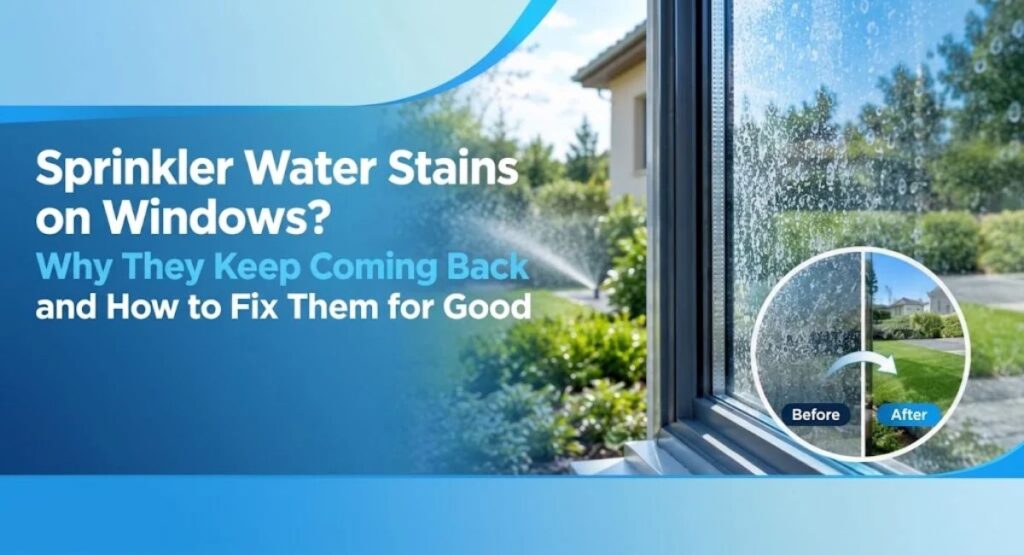
You clean the storefront glass on Monday. By Friday, the white haze is back.
Same spots. Same height. Same pattern.
If that sounds familiar, you are not dealing with dirty windows. You are dealing with a cycle. The sprinklers spray the glass, the water dries, and the minerals stay behind. Each round adds another layer.
This guide explains how to remove sprinkler water stains from windows, and why a simple wipe never solves the problem. You will see how to tell surface minerals from etched glass, how to remove stains in stages, how to adjust sprinkler heads, and how to stop the stains from returning. It is written for HOAs, retail centers, and property managers who see the same staining season after season.
What Sprinkler Stains on Windows Actually Are
Sprinkler water looks clear. It is not pure. Most irrigation water carries dissolved minerals, mainly calcium and magnesium. Water with a high mineral load is called hard water.
When a droplet lands on glass and evaporates, the water leaves. The minerals do not. They dry into a ring or a spot. A single droplet leaves a tiny mark. Hundreds of droplets leave a cloud.
People call these marks many names:
- Sprinkler stains on windows
- Irrigation water spots on glass
- Hard water overspray on windows
- White film or chalky haze
They all describe the same thing. Mineral deposits left behind by irrigation overspray.
The U.S. Geological Survey explains water hardness and why calcium and magnesium cause scale and spotting. It is a useful reference if you want the science behind the problem.
Why Sprinkler Water Leaves White Stains on Glass
The stain is not the water. It is what the water carried.
Here is the process in plain steps:
- The sprinkler head throws water onto the glass.
- Heat and wind dry the droplet.
- Calcium and magnesium crystallize on the surface.
- The next watering cycle adds more minerals on top.
Glass looks smooth. Under magnification, it is not. It has tiny pores and surface irregularities. Minerals settle into those spaces and grip the surface. That is why the film resists a quick wipe.
Heat makes it worse. Glass that sits in direct sun gets hot. Water dries faster on hot glass. Faster drying means tighter bonding between the minerals and the surface.
Some water sources also carry iron. Iron leaves orange or brown marks instead of white ones. If your stains have a rust tint, that is a sign of iron in the supply. The removal approach changes slightly, and a professional should confirm it.
Why the Stains Keep Coming Back
Most property teams clean the glass and stop there. That treats the symptom. The cause is still running on a timer.
There are four common reasons stains return.
The Sprinklers Still Hit the Glass
This is the main cause. A head set a few degrees off, a spray arc that is too wide, or a riser that is too tall will keep wetting the windows. Clean glass will be stained again within days.
The Water Source Is Hard
Reclaimed water, well water, and some municipal supplies carry more dissolved solids. Harder water leaves heavier deposits per droplet. A property can do everything right and still see staining if the water is the issue.
The Landscape Changed
New plants grow. Shrubs push heads out of alignment. Mulch buries nozzles. Crews replace a head with a different model and the spray pattern shifts. The system that worked last year may not work now.
Glass Has a Rough Surface
Once glass has been stained for a long time, the surface changes. It becomes rougher and holds minerals more easily. New deposits bond faster. This is when staining becomes a repeat problem.
Surface Minerals or Etched Glass? How to Diagnose the Damage
This is the most important step. Everything else depends on it.
Surface mineral deposits sit on top of the glass. They can usually be dissolved and removed.
Etching is different. Etching means the glass itself has been damaged. Mineral reactions have eaten into the surface and left permanent microscopic pits. You cannot wipe etching away. It has to be polished out or accepted.
Use the tests below before you start any removal.
The Water Test
Spray clean water on a stained area.
- If the stain looks darker or nearly disappears when wet, then returns as it dries, the damage is likely light surface film or early etching.
- If the stain looks the same wet or dry, the damage is more likely deep mineral scale or etching.
The Fingernail Test
Run a fingernail lightly across the spot. Do this gently.
- If you feel a raised, gritty texture, the deposits sit on top.
- If the glass feels smooth but still looks cloudy, the damage may be inside the surface.
The Angle Test
Look at the glass from the side with sunlight behind you.
- Raised deposits often look like dull rings or crust.
- Etching looks like a frosted, even haze that does not change with cleaning.
The Vinegar Spot Test
Pick a small, low-visibility area. Apply white vinegar to a cloth and press it on the stain for two to three minutes. Wipe it off.
- If the spot improves, you are mostly dealing with surface minerals.
- If nothing changes, the stain is either heavy scale or etched glass.
Here is a quick reference table.
| Sign | Likely Surface Minerals | Likely Etched Glass |
|---|---|---|
| Texture | Rough or gritty | Smooth but cloudy |
| Wet test | Stain fades when wet, returns dry | Stain stays visible when wet |
| Vinegar test | Spot improves | No change |
| Pattern | Rings and droplet shapes | Even frosted haze |
| Age of stain | Weeks to months | Months to years |
No test is perfect. Many windows have both. The top layer is minerals and the lower layer is early etching. That is why staged removal works best.
When Sprinkler Stains Etch Into Glass
People often ask when sprinkler stains etch into glass. There is no exact date. It depends on water chemistry, sun exposure, glass type, and how often the glass gets wet.
Here is what usually speeds up etching:
- Daily or twice daily overspray
- High mineral content in the water
- Direct sun on the stained area
- Long gaps between cleanings
- Harsh or wrong cleaning methods that scratch the surface
In general, stains left for a few weeks are often still on the surface. Stains left for many months, especially in sunny spots, have a higher risk of damage. After a year or more of constant exposure, many properties find some etching beneath the deposits.
This is why timing matters. Early action keeps removal simple and low cost. Late action may require glass restoration.
A real example shows the pattern. A retail center has a row of storefronts facing a landscaped strip. The sprinklers run at dawn. By mid-morning, the lower three feet of glass shows white spotting. The property manager orders a cleaning every quarter. After two years, the cleaning crew cannot fully clear the lower panels. The glass is now partly etched. A cleaning that once cost little now needs restoration work. The sprinklers were never adjusted.
How to Remove Sprinkler Water Stains From Windows: A Stage-by-Stage Approach
Start with the gentlest method. Move up only when needed. This protects the glass and keeps cost down.
Stage 1: Wash and Rinse
Remove loose dirt first. Dirt can scratch glass during later steps.
- Mix mild dish soap with clean water.
- Wash with a soft microfiber cloth or a clean squeegee pad.
- Rinse well and dry with a clean cloth.
Sometimes this alone clears very recent spots. Most of the time, it simply exposes the real stain.
Stage 2: Use a Mild Acid Solution
Minerals dissolve in mild acid. White vinegar is the common starting point.
- Mix equal parts white vinegar and water.
- Apply with a spray bottle or soaked cloth.
- Let it sit for five to ten minutes. Keep the surface wet.
- Wipe in one direction with a microfiber cloth.
- Rinse with clean water.
For vertical glass, a cloth soaked in the solution and pressed against the surface works better than spraying. The liquid does not run off.
Repeat if needed. Light deposits often need two or three rounds.
Cautions:
- Test a small area first.
- Keep acid away from metal frames, anodized aluminum, stone, and grout. Acid can dull or discolor these.
- Rinse thoroughly. Do not let acid dry on glass.
- Wear gloves and eye protection.
Stage 3: Use a Dedicated Hard Water Remover
Commercial glass-safe hard water removers are stronger than vinegar. They are made for mineral scale.
- Follow the label exactly.
- Use a non-scratch pad or a glass-safe scrubber.
- Work in small sections.
- Rinse every section fully before moving on.
Be careful with products that contain hydrofluoric acid. These can etch glass and are hazardous. They are not a do-it-yourself product for property staff.
Our guide on how to remove hard water stains from glass covers the basic cleaning methods in more detail.
Stage 4: Use Polishing for Stubborn Marks
If stains remain after chemical cleaning, the glass may be etched or heavily scaled. This is where polishing comes in.
Glass polishing uses specialty compounds, such as cerium oxide, and controlled equipment. It removes a very thin layer of the surface. That layer holds the damage.
This step needs skill. Done wrong, it can:
- Create visible distortion
- Leave swirl marks
- Overheat and crack the glass
- Leave an uneven finish across a pane
For storefronts, tempered glass, or coated glass, professional service is the safer choice. A trained team can judge how much material can be removed without hurting clarity. A professional water stain removal services in Miami handles both stages: removing mineral scale and treating etched areas.
Stage 5: Know When Glass Needs Restoration or Replacement
Some glass is too damaged to fully recover. Deep etching, pitting, and scratches can remain visible even after polishing. In that case, the options are partial restoration or replacement.
If scratches are also present, read our article on whether you can repair scratched glass. It explains what can and cannot be fixed.
For large panels or historic or custom glass, custom glass restoration in Miami FL can be a better option than replacement. It often costs less and avoids long downtime for tenants.
What to Avoid When Cleaning Sprinkler Stains
Well-meaning staff often make the damage worse. Avoid these habits.
- Razor blades on dry glass. A dry blade scratches glass quickly. Even a clean blade can leave lines.
- Steel wool. It scratches. Fine steel wool also leaves metal flecks that can rust.
- Abrasive powders. They trap grit under the pad and mark the surface.
- Pressure washers on glass. High pressure can drive grit across the glass or force water behind seals.
- Mixing cleaning products. Never mix acids with bleach or ammonia. It can create toxic gas.
- Letting acid dry. Dried acid can stain or etch.
If you are not sure what a product will do, test it in a hidden corner first.
Fix the Source: Sprinkler Head Adjustment Tips
Cleaning without fixing the sprinklers is a loop. You will pay for the same job again and again. The best long-term fix starts at the irrigation system.
Here are practical steps. Most can be done by a landscape contractor or an irrigation technician.
Walk the System While It Runs
Do this once, with a clipboard. Watch each zone near the building. Note every head that touches glass, frames, or walls. Mark them with flags or tape.
Do it at different times of day. Wind changes the spray pattern.
Adjust the Arc and Radius
Most spray heads and rotors have an adjustable arc. Reduce the arc so the spray covers only the lawn or planting bed. Many also have a radius screw. Reduce the throw distance so the water stops short of the building.
Change the Nozzle
A low-angle nozzle keeps the stream flatter. It cuts the distance water travels and lowers drift in the wind. Multi-stream rotating nozzles produce larger droplets with less mist. Large droplets fall closer to the target.
Mist is the worst offender. Fine mist floats farther and settles on glass.
Lower or Move the Head
If a head sits too close to the wall, consider moving it. A head set 12 inches or more from the building gives you more control. Lowering the riser height can also reduce spray angle toward windows.
Switch to Drip or Bubblers Near Glass
For shrubs and flower beds along the building line, drip irrigation is often better than overhead spray. It puts water at the roots, not in the air. Bubblers also work in some cases. This removes overspray in the highest-risk zone.
Check Pressure
High pressure creates mist. A pressure-regulating head or a regulator on the zone can improve spray quality. This also saves water.
Adjust the Schedule
Watering time matters. Early morning irrigation lets plants absorb water before heat builds. But if glass dries in hot sun after each cycle, staining is faster. Talk with your landscaper about shifting cycles or shortening them where plants allow. Do not cut watering so far that plants suffer.
Schedule Regular Inspections
Sprinklers shift. Add a check to your monthly or quarterly routine. Look for:
- Heads pointing at glass
- Broken or cracked nozzles
- Tilted risers
- Growth blocking spray
- Wind drift on open sites
The EPA WaterSense program also offers guidance on efficient outdoor water use, which often reduces overspray too.
Prevention Plan: Combine Irrigation Fixes With a Protective Coating
Sprinkler changes reduce overspray. They do not always remove it. Wind, new plantings, and maintenance mistakes can still send water to the glass.
That is where a protective coating helps.
A ceramic or nano coating creates a thin, hydrophobic layer on the glass. Water beads and rolls off. Fewer droplets stay long enough to dry. Minerals have less to grip. When spots do form, they are easier to wipe away.
Think of it as a safety layer. It does not make glass immune to staining. It reduces how fast stains build and how hard they are to remove.
Key points about protective coatings:
- They work best on clean, polished glass. Apply them after stain removal.
- They do not repair existing etching.
- They need proper application. Surface prep decides how well they bond.
- Maintenance still matters. Regular gentle cleaning keeps the effect strong.
- Results depend on product quality, exposure, and care.
A professional ceramic nano coating is a common choice for storefronts, entry doors, and glass railings. It is most useful where overspray cannot be fully avoided.
A Simple Prevention Plan
Use the table below as a checklist.
| Step | Action | Who Handles It | Timing |
|---|---|---|---|
| 1 | Diagnose stain type | Glass specialist | Before cleaning |
| 2 | Remove minerals and polish if needed | Glass specialist | Once |
| 3 | Adjust arcs, nozzles, and heads | Irrigation tech | Right after cleaning |
| 4 | Apply protective coating | Glass specialist | After irrigation fixes |
| 5 | Inspect sprinklers | Maintenance team | Monthly or quarterly |
| 6 | Rinse and clean glass gently | Janitorial or vendor | Regular schedule |
Order matters. Do not coat glass before the sprinklers are fixed. Do not fix the sprinklers and skip the cleaning. Each step supports the next.
Special Concerns for HOAs, Retail Centers, and Property Managers
Repeat staining is a management issue, not only a cleaning issue. Properties face a few specific challenges.
Many Hands, One Problem
Landscapers control the sprinklers. Janitorial vendors handle the glass. Tenants complain to the manager. No single group owns the whole problem. Staining continues because nobody connects the cause to the effect.
Fix this by assigning one owner. That person coordinates the irrigation fixes, the glass work, and the schedule.
Curb Appeal and Tenant Retention
Stained glass makes a building look neglected. For retail tenants, it hides products and weakens the storefront. For residential communities, it lowers the look of entrances, clubhouses, and common areas. A clear glass front helps leasing and resident satisfaction.
Budget Control
Recurring cleaning is a hidden cost. Quarterly cleaning for a large property adds up. A one-time restoration, irrigation fix, and coating often costs less over a few years. Ask for a full proposal that covers the cycle, not only one visit.
Documentation
Keep a simple record of:
- Dates of cleaning
- Which panels were treated
- Irrigation changes made
- Coating dates and products used
This helps with vendor accountability, warranty claims, and budget reviews. It also helps new managers understand the history.
Safety and Liability
Cleaning glass on tall storefronts or in public areas needs proper equipment. Chemicals near foot traffic need signs and barriers. Use licensed, insured vendors when the work goes beyond routine cleaning.
DIY or Professional Service? How to Decide
Some stains are easy to handle in-house. Others are not.
DIY may work when:
- Stains are recent, within a few weeks
- Glass is small, low, and easy to reach
- The vinegar test improves the glass
- The glass is plain, uncoated, and not tempered with special films
Call a professional when:
- Stains have been present for months or years
- The glass is large, high, or part of a storefront
- The stain does not respond to mild acid
- You suspect etching
- The glass has a coating, tint, or film
- You need a long-term plan, not a one-time clean
Professionals also bring the right tools, safety gear, and experience in judging how much correction glass can take. That reduces the risk of costly mistakes.
Questions Property Managers Ask Most
What removes sprinkler stains from windows?
Start with soap and water. Then use white vinegar and water on mineral deposits. If stains stay, use a glass-safe hard water remover. For etched glass, professional polishing is usually required.
Can sprinkler water damage glass permanently?
Yes. If minerals stay on the glass for a long time, they can etch the surface. Etching is permanent unless the glass is polished or restored.
Does vinegar remove sprinkler stains?
Vinegar works on light to moderate mineral deposits. It will not repair etched glass. It can also harm metal and stone around the window, so protect those surfaces.
How do I stop sprinklers from staining my windows?
Aim heads away from glass. Reduce arc and radius. Use low-angle or large-droplet nozzles. Switch to drip near the building. Then add a protective coating for extra control.
Is there a protective coating for sprinkler overspray?
Yes. Ceramic and nano coatings help water bead off glass. This reduces mineral buildup and makes cleaning easier. They work best when combined with irrigation fixes.
How do I remove irrigation stains from storefront glass?
Test the stain type first. Clean in stages, from soap to mild acid to specialty removers. Large storefront panels with heavy staining are best handled by a trained glass restoration team.
How often should glass be cleaned if sprinklers hit it?
If overspray continues, glass may need cleaning every few weeks. The better goal is to fix the overspray so cleaning can return to a normal schedule.
A Realistic Timeline for a Full Fix
What does a proper solution look like? Here is a typical path for a commercial property.
Week one: Inspect the glass and sprinklers. Run the diagnostic tests. Mark problem heads.
Week two: Remove mineral deposits. Polish any etched panels the team can safely correct.
Week three: Adjust or replace sprinkler heads and nozzles. Change the schedule if needed.
Week four: Apply a protective coating to the cleaned glass. Document the work.
Ongoing: Inspect sprinklers regularly. Clean glass gently on a set schedule. Reapply or refresh the coating as the product maker advises.
This order saves money. It avoids repeated cleanings and protects the glass for years.
Final Takeaway: Stop the Cycle, Not Only the Stain
Sprinkler water stains return because the source is still active. Cleaning alone only resets the clock.
The path is simple. Diagnose the stain. Remove it in stages. Adjust the sprinklers. Add a protective coating. Keep a basic inspection routine. Done in this order, the problem usually stays solved.
If your property has repeat staining, or you suspect the glass is already etched, get a professional assessment before the damage grows. Vivid Clear Glass specializes in hard water stain removal, glass restoration, and protective coatings for commercial and residential properties. Visit our water stain removal page or contact our team to schedule an inspection and get a clear plan for your glass.