
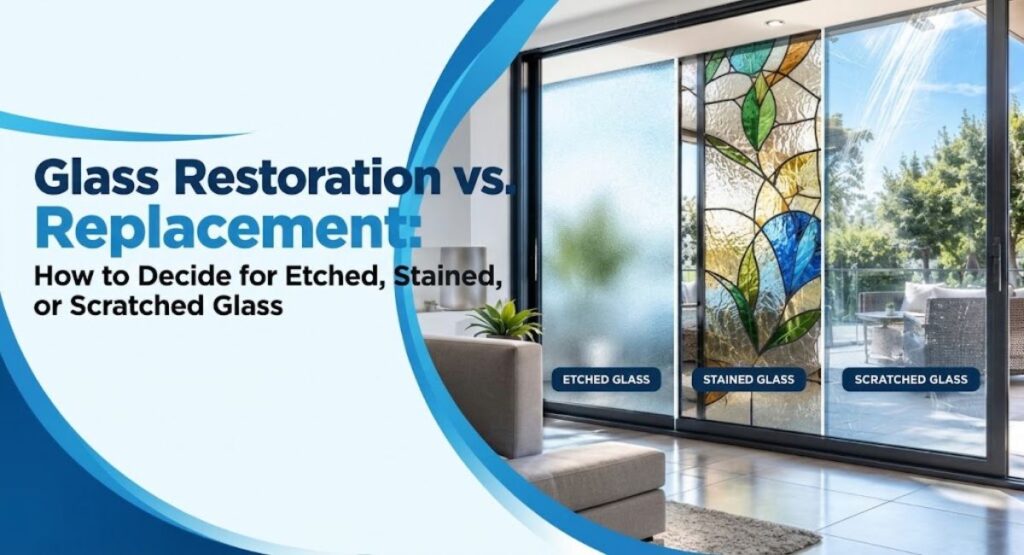
The storefront glass looks tired. White haze covers the lower panes. A few scratches catch the light. A tenant has complained twice.
You have two options. Restore the glass or replace it.
The wrong choice costs real money. Replace too soon, and you pay for glass that could have been saved. Restore too late, and you pay twice: once for work that does not hold, and again for new glass.
This guide gives you a clear way to decide. It compares restoration and replacement on cost, downtime, lead time, appearance, longevity, and warranty. It includes a damage-type matrix for etching, mineral buildup, scratches, and coating failure. It also walks through a commercial case study that shows both outcomes. It is written for property managers, facility managers, building owners, and homeowners with damaged glass.
What Restoration and Replacement Each Involve
Start with the basics. The two paths are very different.
Glass Restoration
Restoration repairs the glass you already have. The work depends on the damage. It can include:
- Chemical removal of mineral deposits and stains
- Cleaning paint, overspray, and residue
- Machine polishing to reduce scratches and light etching
- Cleaning frames and tracks
- Applying a protective coating afterward
The glass stays in the frame. Most jobs finish in hours or days. A professional custom glass restoration service can handle many forms of cosmetic damage without removing a pane.
Glass Replacement
Replacement removes the damaged unit and installs a new one. The process includes:
- Measuring the opening
- Ordering glass, often cut to size
- Removing the old glass and sealants
- Installing the new unit with new glazing materials
- Cleaning up and disposing of the old glass
Replacement gives you a new product. It also brings lead times, higher material cost, and disruption.
Know What Type of Damage You Have
The right choice starts with the right diagnosis. Four types of damage account for most cases.
Mineral Buildup
Mineral buildup comes from hard water, such as irrigation overspray, rain runoff, or shower spray. The minerals sit on the surface. Early deposits are removable. Our guide on removing hard water stains from glass explains what that looks like and how it is done.
Etching
Etching is damage to the glass itself. Minerals, alkaline residue, or chemicals can eat into the surface and leave a frosted look. Etching is permanent unless the glass is polished or replaced. Light etching may improve with polishing. Deep etching may not.
Scratches
Scratches come from abrasive tools, grit, tools used wrongly, or impact. Light scratches may be polished on some glass. Deep scratches are harder. They can also be a concern on tempered glass. Our article on how do you fix scratched glass covers this in more detail.
Coating Failure
Some glass carries low-E, reflective, or other coatings. These coatings can peel, haze, or corrode over time, especially where moisture reaches them. Coating damage is often not fixable by cleaning or polishing. It may mean replacement.
Many windows have more than one type of damage at once. A pane can have mineral film on top, light etching below, and a few scratches. Mixed damage calls for a careful assessment.
How to Assess Damaged Glass Yourself
You can do a first check before calling anyone. It is not a final diagnosis. It helps you ask better questions.
- Clean a small test area. Use soap and water. Remove dirt first.
- Check wet and dry. Spray with clean water. Stains that fade when wet and return when dry are often surface minerals. Damage that stays visible when wet may be etching or scratches.
- Use side light. Look from a low angle. Scratches and haze show up more clearly.
- Feel the surface. Run a fingernail gently across it. A gritty texture suggests surface deposits.
- Check both sides. Damage on the inside surface of an insulated unit cannot be reached.
- Look at the edges. Fog, moisture, or discoloration between panes suggests a failed seal.
- Photograph everything. Use the same lighting for before and after photos.
If you see moisture or fog between panes, stop here. A failed insulated glass seal is not a cleaning problem. Replacement of the unit is the usual fix.
When Restoration Is Usually the Better Choice
Restoration fits best when the damage is on the surface or shallow, and the glass is otherwise sound.
Typical cases include:
- Hard water stains and mineral scale that have not etched the glass
- Paint, stucco, or adhesive residue
- Light scratches
- Early etching that responds to polishing
- Graffiti that has not damaged the surface
- Large panels that are expensive or slow to replace
- Custom, laminated, or hard-to-source glass
- Situations where downtime must be short
Restoration also helps when the glass is in good shape and the owner wants to protect the investment. A water stain removal service can often return heavily spotted glass to a clear condition when the deposits have not caused deep damage.
When Replacement Is Usually the Better Choice
Some glass cannot be saved. Replacement is the right call when:
- The glass has cracks, chips near edges, or structural damage
- An insulated glass unit has a failed seal and internal fogging
- Etching or scratches are deep and widespread
- Polishing would distort reflections or weaken the glass
- A coating has failed across the surface
- The cost of restoration comes close to new glass
- Safety codes or building standards require new glazing
- You plan an energy upgrade at the same time
Replacement can also make sense for old glass with other problems. If a frame is failing and glass is near the end of its life, one project may cover both.
When shopping for new glazing, energy performance ratings matter. The National Fenestration Rating Council is a nonprofit that rates windows, doors, and skylights for energy performance. Its labels help you compare products.
Side-by-Side Comparison: Cost, Downtime, Lead Time, Appearance, Longevity, and Warranty
Use this table as a decision tool. It shows general patterns. Each project differs.
| Factor | Restoration | Replacement |
|---|---|---|
| Cost | Usually lower for surface damage. Rises with severity and access. | Higher. Includes glass, labor, removal, disposal, and sometimes framing work. |
| Downtime | Often hours to a few days | Days to weeks, depending on glass and installation |
| Lead time | Short. Often scheduled within days. | Can be long for custom, laminated, or insulated units |
| Appearance | Often clear and uniform when damage is shallow. Deep damage may leave faint marks. | New and uniform. Color or tint may differ from nearby old glass. |
| Longevity | Depends on the cause. Lasts longer when the source is fixed and a coating is applied. | Long life, but new glass faces the same exposure if the source remains |
| Warranty | Workmanship warranty from the contractor. Terms vary. | Manufacturer warranty on the glass and installer warranty on labor |
| Disruption | Lower. Work happens in place. | Higher. Removal, installation, and cleanup |
| Environmental impact | Keeps existing glass in use | Creates waste, though some glass can be recycled |
For many owners, downtime and lead time decide the question. A tenant with a broken storefront cannot wait weeks. A tenant with hazy glass may be able to wait a day for restoration.
For a deeper look at budget factors, read our guide on how much glass restoration costs.
Damage-Type Matrix: Which Route Fits Best
This matrix matches common damage types to the usual best path. It is a guide, not a promise. Always confirm with an inspection.
| Damage Type | Light | Moderate | Severe |
|---|---|---|---|
| Mineral buildup | Restore | Restore, likely with polishing | Restore if etching is shallow. Replace if deep etching is widespread. |
| Etching | Restore with polishing | Restore with caution. Test a section first. | Replace in most cases |
| Scratches | Restore with polishing on suitable glass | Evaluate by glass type. Tempered glass raises risk. | Replace in most cases |
| Coating failure | Evaluate. Cleaning may help if the issue is surface film. | Often replace | Replace |
| Mixed damage | Restore | Restore in stages and reassess | Replace or restore only high-visibility areas |
| Failed insulated seal | Replace the unit | Replace the unit | Replace the unit |
| Cracks or chips | Replace | Replace | Replace |
How to read it: find your damage type, find your level, and follow the suggested path. If your damage sits between levels, ask for an inspection.
Glass Type Changes the Answer
Glass type affects what is safe. It can tip the decision.
Annealed Glass
This is standard glass. It is the easiest to restore. It can be polished with the right method.
Tempered Glass
Tempered glass has surface compression. It is strong against impact, but heavy polishing carries more risk and cannot be reversed. Contractors limit what they do on tempered panels. Deep scratches often lean toward replacement.
Laminated Glass
Laminated glass has an interlayer between panes. Surface damage may be restorable. Edge damage or delamination usually means replacement.
Insulated Glass Units
These are two or more panes with a sealed space. Surface cleaning on the outside is possible. Damage on interior surfaces or seal failure points toward replacement.
Coated or Filmed Glass
Coatings and films limit methods. Some coatings sit on exterior surfaces and are fragile. A specialist must identify the coating before any work.
When you do not know your glass type, ask the original installer or the manufacturer. Many units carry an etched mark in a corner that identifies the product and tempering.
How Long Does Glass Restoration Last?
This is a common question, and the honest answer is that it depends.
Three things matter most.
The Cause of the Damage
If the cause continues, damage returns. Sprinklers that hit the glass will leave new stains. Roof runoff that streaks the glass will keep streaking it. Restoration without source control is temporary. Our guide on sprinkler water stains shows how irrigation fixes protect restored glass.
Surface Protection
A protective coating helps water bead off and can slow buildup. It does not stop all damage. Results depend on the product, how well the glass was prepared, and the exposure.
Maintenance
Regular gentle cleaning keeps glass in good shape. Neglect shortens the life of any fix.
If damage was surface-level and the source is fixed, restoration can last for years. If the source remains, results may last months. A contractor should give you a realistic range based on your site.
Does Restored Glass Look New?
Often it looks very close to new. Not always.
The result depends on the starting condition.
- Surface minerals and residue: The glass often returns to a clear look.
- Light scratches and etching: Polishing can reduce them. Some faint marks may remain under certain light.
- Deep damage: Polishing may improve the look but not fully erase it.
Polishing removes a thin layer of glass. If it goes too far, it can create optical distortion. A skilled contractor stops before that point. Sometimes that means accepting a small trace of damage.
If the glass must be perfect, such as for a luxury showroom, replacement may be the safer choice. Ask the contractor to show a test area before you commit.
Business Impact: Downtime and Lead Time
For commercial properties, time often matters as much as money.
Downtime
Restoration usually happens in place. Work may be done at night or on a weekend. Many storefronts stay open or close for a short time.
Replacement may require boarding, temporary barriers, or closing an entrance. Security is a concern when glass is out. Tenants lose visibility and foot traffic.
Lead Time
Standard clear glass may arrive quickly. Custom sizes, tempered units, laminated glass, tints, and coated insulated units can take weeks. Delays can come from supplier backlogs or special orders.
Ask for lead times in writing. Plan temporary protection if needed.
Scheduling and Access
Both options need access. Replacement of upper-floor glass needs lifts, cranes, or other equipment. Restoration may also need lifts. Ask each contractor about access and safety plans.
Commercial Case Study: Two Paths for the Same Storefront
This is a composite example based on common situations. It is not a record of one specific client.
A small retail center has twelve large storefront panes. They face a landscaped strip. Sprinklers have hit the lower panes for several years. The glass shows heavy white staining, some haze, and a few scratches from past cleaning attempts. Tenants complain that the shops look neglected.
The property manager gets two bids.
Path A: Replace All Twelve Panes
The contractor quotes new tempered glass for all twelve openings.
- Cost: High. The quote includes glass, labor, disposal, and sealants.
- Lead time: Several weeks, due to custom sizes and tempering.
- Downtime: Each opening needs temporary protection. Entrances are affected.
- Appearance: New and uniform.
- Risk: If the sprinklers are not fixed, the new glass faces the same staining.
Path B: Inspect, Restore, Fix the Source, and Coat
A restoration team inspects every pane and tests small areas.
- Ten panes show surface minerals and light etching. They can be restored.
- Two panes have deeper etching and several scratches. They are listed as replacement candidates.
- The team recommends adjusting sprinkler heads and applying a protective coating after restoration.
The plan:
- Restore ten panes over a few nights.
- Replace the two worst panes.
- Adjust sprinklers.
- Apply a ceramic coating to restored glass.
Result:
- Cost: Lower than replacing all twelve, even with two new panes and the added service.
- Lead time: Short for restoration. The two replacement panes follow the normal order cycle.
- Downtime: Minimal for most tenants.
- Appearance: Restored panes look clear. Two new panes may differ slightly in tone, so the team checks that before ordering.
- Risk: Lower, since sprinklers are fixed and glass is protected.
What the Case Shows
The best result was neither all restoration nor all replacement. It was a mix, based on inspection. The owner also saved money by fixing the source.
The lesson is simple. Assess each pane. Do not decide for the whole building from one window.
How to Build Your Own Decision Framework
Use this step-by-step process.
- Inventory the glass. Count panes. Note size, location, and type.
- Diagnose each pane. Use the checks above. Group panes by damage level.
- Identify the cause. Fix sprinklers, runoff, or construction issues.
- Get two options. Ask for restoration and replacement pricing where the damage is borderline.
- Compare time and disruption. Include lead times and downtime in the cost.
- Check warranties. Ask what each contractor covers and what voids it.
- Decide by pane group. Restore what is sound. Replace what is not.
- Protect the result. Consider a coating and a maintenance plan.
- Document the work. Keep photos and records.
This method keeps decisions grounded in evidence. It also gives you a record for owners, tenants, and insurers.
Warranty and Liability Considerations
Warranty terms differ between the two paths.
Restoration Warranties
Contractors may offer a workmanship warranty. It often covers the quality of the work for a set period. It may not cover new damage from the same source, such as sprinklers that still hit the glass. Read the exclusions.
Replacement Warranties
New glass often comes with a manufacturer warranty against defects. Installers may add a labor warranty. Improper cleaning or abrasive tools can void it. Keep cleaning instructions.
Existing Warranties
Check whether your current glass is still under warranty. A restoration method not approved by the manufacturer could affect coverage. Ask before work begins.
Liability
If damage came from construction or another party, they may owe cleanup or repair. Document the cause. This article is general information, not legal advice. Review your contracts and talk to an attorney or insurance professional if needed.
Red Flags When Comparing Bids
Watch for these signs in either type of estimate.
- A firm price without an inspection
- A promise of perfect results
- No question about glass type
- Pressure to decide today
- Vague scope and no written exclusions
- No proof of insurance
- A refusal to say which products or methods will be used
- A recommendation to replace everything without testing
- A recommendation to restore everything without a test area
A trustworthy contractor will explain both options and tell you honestly when one makes more sense.
Answer To Common Questions Property Owners Ask Most
Is it cheaper to restore or replace glass?
Restoration is often cheaper for surface damage like mineral stains and light scratches. Replacement costs more but is needed for cracks, failed seals, and deep damage.
When is glass beyond restoration?
Glass is usually beyond restoration when it has cracks, failed insulated seals, deep etching, deep scratches over large areas, or failed coatings. A professional inspection confirms it.
Can etched glass be repaired?
Light etching can sometimes be reduced by polishing. Deep etching often cannot be fully removed without distortion. In that case, replacement is the better option.
Does restored glass look new?
Often it looks clear and uniform, especially when the damage was shallow. Deeper damage may leave faint traces. A test area shows what to expect.
How do I assess damaged commercial glass?
Clean a test spot, check wet and dry, view in side light, and inspect the edges for seal failure. Photograph the glass and request a professional inspection for borderline cases.
What is the cost of replacing storefront glass compared to restoring it?
Replacement usually costs more, especially for large, tempered, or custom units, and it takes longer. Restoration costs less when the glass is sound. Request both quotes when damage is borderline.
Should I replace one pane or all panes?
Decide pane by pane. Replace only the units that fail inspection. Restore the rest. Keep in mind that new glass may look slightly different from old glass next to it.
Inspect First, Decide by Evidence
Restoration and replacement are both good tools. The mistake is picking one without looking at the glass.
Check the damage type. Check the glass type. Compare cost, downtime, lead time, appearance, longevity, and warranty. Fix the source of the damage. Decide pane by pane.
If your property has etched, stained, or scratched glass and you are unsure which way to go, Vivid Clear Glass can inspect the glass and give you an honest recommendation. Our team handles stain removal, scratch correction, overspray cleanup, and protective coatings, and will tell you when replacement is the better choice. Contact Us to schedule an inspection and get a clear written plan.